Dr. Courtney B. Watson currently works as a postdoctoral scholar at the Harvard & Smithsonian, Center for Astrophysics with Dr. Kim-Vy Tran as the project and data manager for the AGEL Survey. In this role she has built the framework for the AGEL survey workflows and policies for handling AGEL data. In addition, she established the permanent AGEL data archive to house all the data from the survey as well as individual researchers. See the projects page for more info.
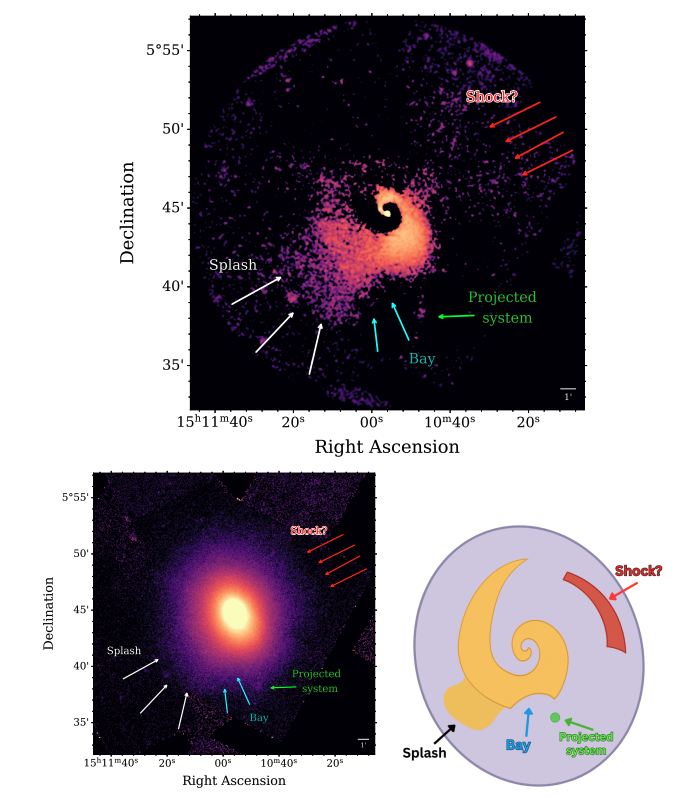
We present results from very deep (485 ks) Chandra X-ray observations of the relaxed, cool core cluster A2029 (z = 0.0767). A2029 hosts one of the longest, most continuous sloshing spirals ever observed, which we find extends nearly 600 kpc from the cluster core. In addition to providing detailed views of the sloshing spiral, imaging and spectroscopic analysis reveals intracluster medium (ICM) substructure related to the merger history, including a broad "splash" of cooler gas and a potential merger shock. The radio lobes of the central WAT source show evidence of alignment with the sloshing motions, consistent with ICM bulk flow, rather than host-galaxy motion, as the primary driver of lobe bending. Comparison to a 1:10 mass-ratio off-axis merger simulation indicates that the observed ICM structures are relics of a second core passage of a subcluster ∼4 Gyr after the start of the merger, where the "splash" feature is revealed to be a wake of cool gas trailing behind the subcluster. Overall, our results suggest that A2029 is still settling from past interactions—showing that even the initially most relaxed-looking clusters can be hiding a rich history of dynamical activity.
@article{Watson2025b,author={Watson, Courtney B. and Blanton, Elizabeth L. and Randall, Scott W. and Clarke, Tracy E. and ZuHone, John A.},doi={10.3847/1538-4357/ae2026},journal={The Astrophysical Journal},pages={106},title={Deep Chandra X-Ray Observations of A2029: The Merger History of a Relaxed, Strong Cool Core Cluster},url={https://doi.org/10.3847/1538-4357/ae2026},volume={996},year={2025},dimensions={true},}
ApJ
HST Grism Observations of a z ∼ 1 . 8 Cluster Candidate from the Clusters Occupied by Bent Radio AGN ( COBRA ) Survey
Courtney B Watson, Elizabeth L Blanton, Emmet Golden-marx, and 2 more authors
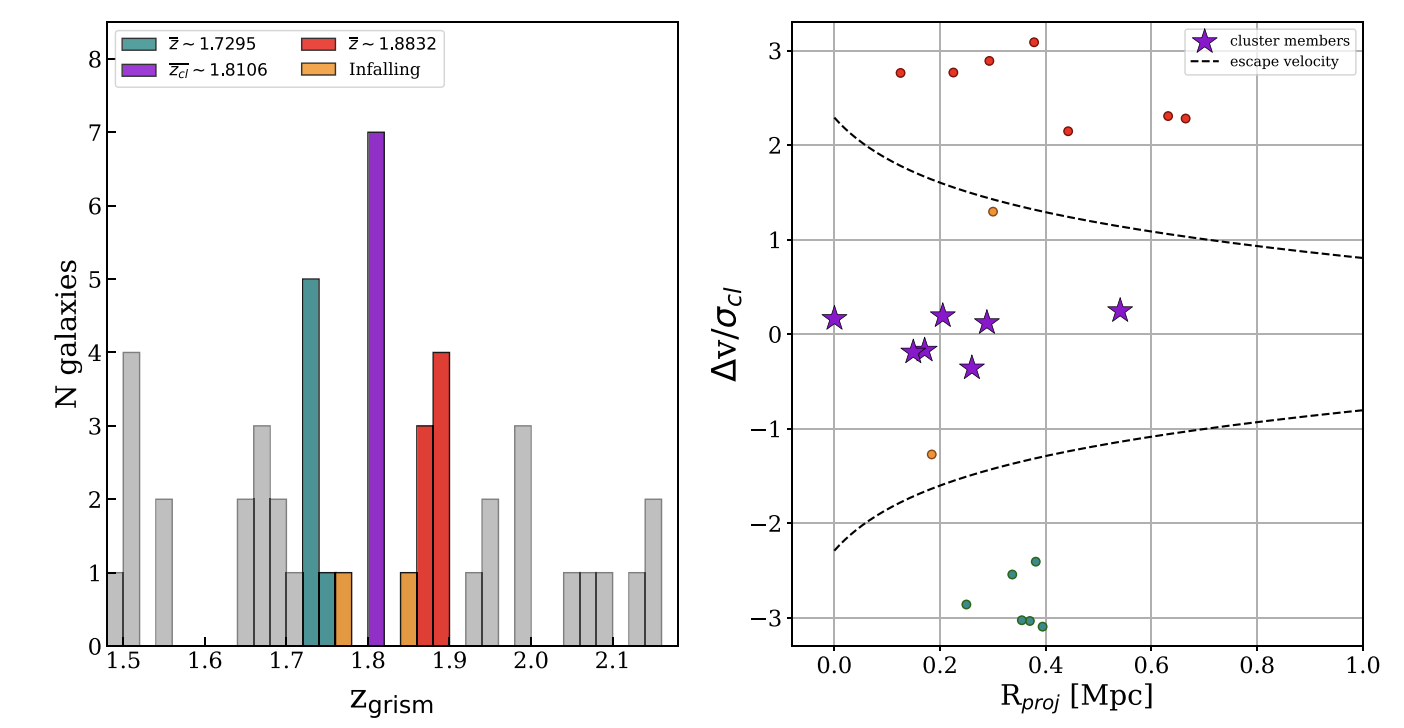
We present new Hubble Space Telescope/Wide Field Camera 3 G141 grism observations for COBRA 1411+3415, originally identified as a high-redshift cluster candidate in the Clusters Occupied by Bent Radio AGN (COBRA) survey using radio, infrared, and optical data. We spectroscopically identify seven cluster members within a 0.5 Mpc radius with grism redshifts in the range 1.8006 ≤ zgrism ≤ 1.8175, consistent with COBRA 1411+3415 being a high-redshift cluster with a mean redshift of 〈zgrism〉 = 1.8106 ± 0.0006. The detection of seven galaxies within this small redshift range is significant above the background distribution of galaxies at the level of 5σ. The line-of-sight velocity dispersion of the cluster is found to be σ∥ = km s−1 with a virial mass of M200 ≈ × 1014 M⊙. However, the mass may be lower if the cluster is still in formation. In projected phase space, we also identify two possible infalling members of COBRA 1411+3415 and two additional structures at z ∼ 1.73 and z ∼ 1.88. The similar spatial distributions and small projected separation from the main cluster suggest they could be a part of the same large-scale filament and together may form a protocluster system that could eventually merge to form a single, massive cluster. COBRA 1411+3415 is the highest-redshift cluster to be spectroscopically confirmed using a bent, double-lobed radio source as a cluster tracer.
@article{Watson2025a,author={Watson, Courtney B and Blanton, Elizabeth L and Golden-marx, Emmet and Ashby, Matthew L N and Randall, Scott W},doi={10.3847/1538-4357/adc410},issn={1538-4357},journal={The Astrophysical Journal},pages={57},title={HST Grism Observations of a z ∼ 1 . 8 Cluster Candidate from the Clusters Occupied by Bent Radio AGN ( COBRA ) Survey},url={http://dx.doi.org/10.3847/1538-4357/adc410},volume={984},year={2025},dimensions={true},}
ApJ
Chandra X-Ray Observations of Abell 119: Cold Fronts And A Shock In An Evolved Off-Axis Merger
Courtney B. Watson, Elizabeth L. Blanton, Scott W. Randall, and 4 more authors
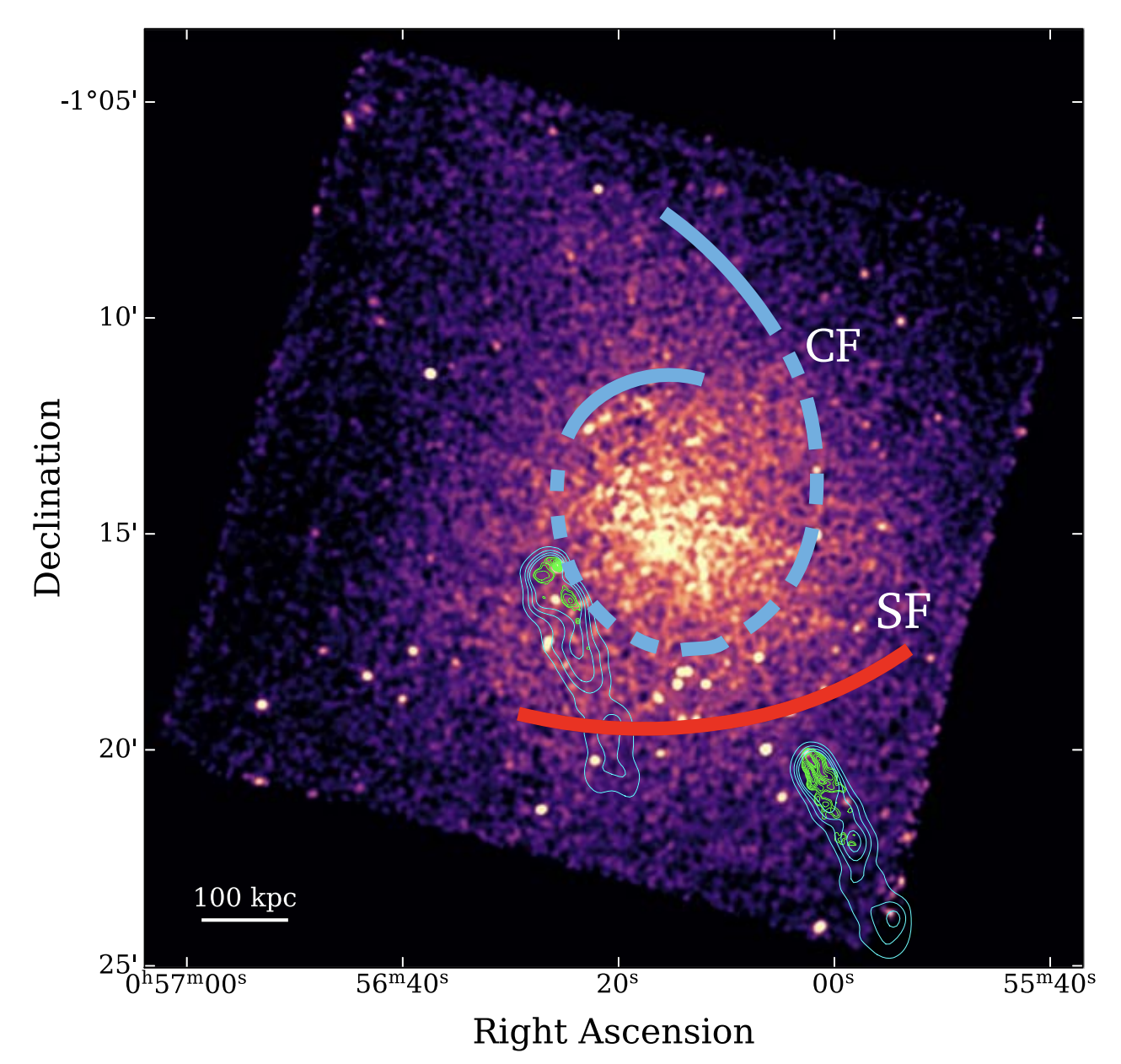
We present \backslashchandra X-ray observations of the dynamically complex galaxy cluster Abell 119 (}z = 0.044}). A119 is host to two NAT radio sources (0053-015 \backslash& 0053-016) whose tails are oriented parallel to each other despite orthogonally oriented jet axes. Imaging and spectral analysis reveal X-ray emission elongated along the NE-SW axis along with the presence of complex structures, including surface brightness discontinuities, which suggest possible merger activity along this axis. From radial profiles of the X-ray surface brightness, temperature, pressure, and density, we identify two surface brightness edges which are found to be cold fronts, possibly associated with large-scale sloshing of ICM gas. We also identify a brightness edge to the south which is found to be a shock front with Mach number }M = 1.21 \backslashpm 0.11}, consistent with a merger shock. In addition, previous optical studies show alignment of optical substructures along the north-south direction. The elongated X-ray emission, orientations of the NAT tails, and alignment of optical substructure all suggest recent or on-going merger activity in the NE-SW direction.
@article{Watson2023,author={Watson, Courtney B. and Blanton, Elizabeth L. and Randall, Scott W. and Sarazin, Craig L. and Sarkar, Arnab and ZuHone, John A. and Douglass, E. M.},doi={10.3847/1538-4357/acee74},issn={15384357},journal={The Astrophysical Journal},number={2},pages={103},title={Chandra X-Ray Observations of Abell 119: Cold Fronts And A Shock In An Evolved Off-Axis Merger},url={https://ui.adsabs.harvard.edu/abs/2023ApJ...955..103W},volume={955},year={2023},dimensions={true},}